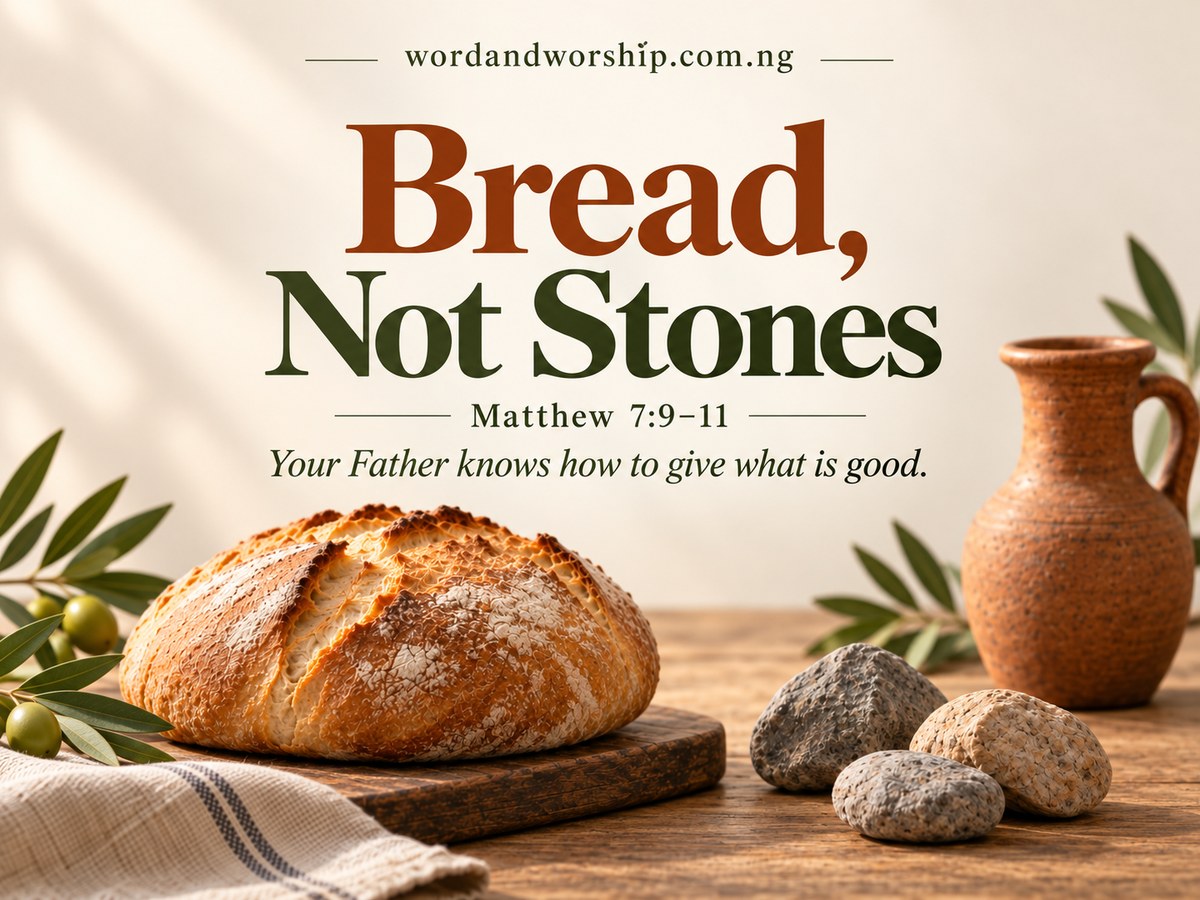
Scripture: Matthew 7:9–11
Song: Does Jesus care?
“Or what man is there of you, whom if his son ask bread, will he give him a stone? Or if he ask a fish, will he give him a serpent? If ye then, being evil, know how to give good gifts unto your children, how much more shall your Father which is in heaven give good things to them that ask him?” — Matthew 7:9–11 (KJV)
There are things people feel about God but are afraid to say. It sounds wrong to question His goodness, so we keep quiet. Yet somewhere beneath the prayers and worship, a troubling thought may already be growing: “If God loves me, why is He allowing me to go through this?”
Pain does not only make us wonder whether God has forgotten us. Sometimes, it makes us wonder whether He is being unkind. We ask for bread and it feels as though life keeps giving us stones. We ask for relief and another problem appears. After being hit repeatedly, the heart may begin to see God as someone who watches suffering without concern.
Jesus understood that people could think this way about the Father. That is why He asked a simple question: What father would hear his hungry son asking for bread and deliberately place a stone in his hand?
A stone may resemble a small loaf of bread, especially from a distance, but it cannot satisfy hunger. Imagine the cruelty of raising a child’s hope only to give him something useless. Jesus then asked whether a father would give his child a serpent after the child asked for fish. This would go beyond disappointment. It would mean giving the child something dangerous in place of what he needed.
Even flawed parents know that such behaviour is wicked. They may not have everything their children want, and they may sometimes make poor decisions, but love makes them desire good for their children. Jesus then turned the question towards God: “How much more shall your Father which is in heaven give good things to them that ask him?”
How much more!!!!!! Those words should correct the image of God that suffering sometimes leaves in our minds. God is not less compassionate than the kindest parent you have ever known. He does not enjoy watching you struggle; He does not raise your hopes so that He can laugh when they collapse. He does not place harm in your path and call it bread; God is not playing with your life.
Still, there are times when what He allows does not feel good. A closed door, a long delay. His refusal to give us what we requested may look harsh, especially when the request itself appears reasonable. We may begin to wonder whether He heard us correctly.
But Jesus did not say that the Father would give us everything we called good. He said the Father gives “good things.” A child knows what he wants, but a good father knows what is safe, what is needed and what the child cannot yet see. This does not mean that every painful experience came directly from God or that we should call evil good. It means that even in a broken world, God will not become wicked because life has become painful.
Joseph could not have called the pit good. There was nothing good about slavery or the false accusation that sent him to prison. Those things were evil, and the people responsible for them meant evil. Yet years later, Joseph could say that God had not allowed their wickedness to have the final word. What they meant for evil, God turned towards the preservation of many lives.
The cross tells the same truth more boldly. Men acted wickedly against Jesus. He was betrayed, falsely accused, mocked and crucified. God did not call their actions good. Yet He brought salvation out of the place that looked like complete defeat. If God could bring redemption out of Calvary, then the worst thing that has happened to you is not beyond His power to touch.
You may not yet know what He is doing with your story. Some parts may never make sense while you are still standing inside them. But do not allow your pain to place wickedness in God’s heart. You may question His methods and His timing. You may tell Him that you do not understand why He did not stop something from happening. But remember who Jesus said He is: your Father. He is not a stranger deciding whether your case deserves attention nor an enemy looking for another way to hurt you.
He gave His Son for you before you knew how to ask. So come to Him again. Bring the anger, the disappointment and the questions you have hidden. Ask Him to heal the part of you that has become suspicious of His love.
As you pray, hold on to these words: “How much more.”
If an earthly parent can be moved by the cry of a child, how much more will your Father hear you? If human hands can reach out in compassion, how much more are His hands ready to help? If imperfect people can desire good for those they love, how much more does God desire good for you?
Prayer
Father, I do not understand everything You have allowed, but I refuse to call You wicked. Show me Your goodness in the very place where I have questioned it. Put bread in these waiting hands, and let my life become proof that You have always been a good Father.
Leave a Reply